
Losing most or all of your teeth doesn’t necessarily mean you need traditional removable dentures. Modern implant dentistry offers full-arch solutions that can restore your smile using a relatively small number of dental implants.
One of these approaches is All-on-X dental implants, a flexible treatment concept that uses a carefully selected number of implants to support a complete arch of replacement teeth.
But what exactly does All-on-X mean? Is it different from All-on-4 or All-on-6, and which option offers the best long-term results?
In this guide, we’ll explain how All-on-X implants work, compare different implant configurations, and explore treatment costs, recovery, longevity, and potential risks to help you make an informed decision.
Table of Contents
What Are All-on-X Dental Implants?
All-on-X dental implants are a full-mouth tooth replacement approach in which a complete upper or lower arch of artificial teeth is supported by multiple dental implants.
The term “X” refers to the number of implants used, which varies according to the patient’s anatomy, bone quality, and treatment requirements.
For example:
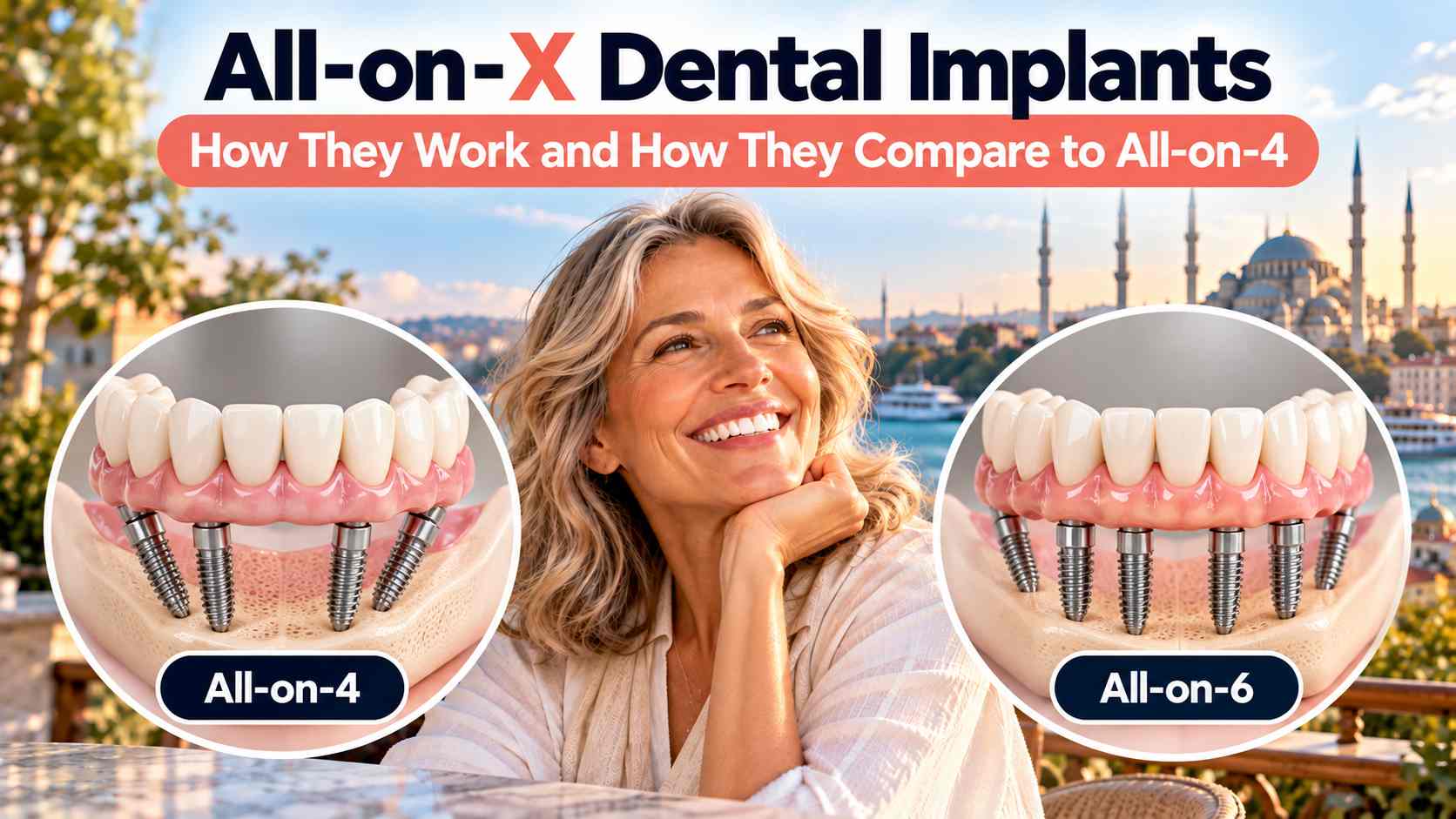
- All-on-4: Four implants support a full arch of replacement teeth.
- All-on-6: Six implants support a full arch.
- All-on-X: A broader concept that may involve four, five, six, or another clinically appropriate number of implants.
Unlike traditional dentures, fixed All-on-X restorations are secured to implants placed in the jawbone rather than relying primarily on the gums for support.
This can provide greater stability when eating, speaking, and smiling.
All-on-X is not a single standardized surgical technique. The number and positioning of implants, prosthetic materials, and treatment timeline are determined through individualized planning.
All-on-X vs All-on-4 vs All-on-6: What’s the Difference?
The main difference between All-on-X, All-on-4, and All-on-6 is the number of implants supporting the replacement teeth.
All-on-4 and All-on-6 are specific configurations within the broader All-on-X approach.
| Feature | All-on-4 | All-on-6 | All-on-X |
| Number of implants | 4 | 6 | Individually selected |
| Full-arch replacement | Yes | Yes | Yes |
| Implant positioning | Often includes angled posterior implants | Depends on anatomy and treatment plan | Customized |
| Bone requirements | May work in selected cases with limited bone | Requires suitable placement sites | Depends on configuration |
| Initial cost | Often lower | Often higher | Varies |
| Same-day temporary teeth | Possible in suitable cases | Possible in suitable cases | Depends on stability and planning |
| Best suited for | Selected full-arch cases | Cases where six implants are appropriate | Patients needing individualized planning |
All-on-X vs All-on-4: Which Is Better?
All-on-4 uses four strategically positioned implants, often including angled posterior implants, to support a full-arch restoration.
The technique can be useful when available bone is limited in certain areas, potentially reducing the need for additional bone augmentation in selected patients.
All-on-X provides greater flexibility because the treatment isn’t restricted to four implants.
A dentist may recommend additional implants when the patient’s anatomy, bite forces, or prosthetic requirements justify them.
However, more implants don’t automatically mean better results. Implant positioning, bone quality, prosthetic design, and maintenance are also critical.
All-on-4 vs All-on-6: Is Six Implants Better Than Four?
Six implants may provide additional support and distribute forces across more implant sites in some cases.
They may also offer greater flexibility when designing certain restorations.
However, six implants require sufficient suitable bone and may increase surgical complexity and cost.
Four well-positioned implants can successfully support a full-arch restoration in appropriately selected patients.
The best configuration depends on clinical assessment rather than implant count alone.
Patients considering treatment abroad can explore All-on-4 dental implants in Turkey and All-on-4 treatment in Hungary to compare available options.
Who Is a Good Candidate for All-on-X Implants?
All-on-X dental implants are generally considered for patients who have lost most or all teeth in one or both jaws, or whose remaining teeth cannot be predictably maintained.
You may be a candidate if you:
- Have multiple missing or severely damaged teeth.
- Struggle with loose or uncomfortable dentures.
- Want a fixed alternative to removable dentures.
- Have sufficient bone for a suitable implant configuration.
- Have generally stable oral and medical health.
- Can maintain good oral hygiene and attend follow-up appointments.
Can You Get All-on-X With Bone Loss?
Some patients with reduced jawbone volume may still qualify for All-on-X treatment.
Angled implant placement and other planning techniques can sometimes make use of available bone without extensive grafting.
However, severe bone loss may require additional procedures or alternative implant approaches.
A clinical examination and three-dimensional imaging, usually cone-beam computed tomography (CBCT), help determine whether treatment is feasible.
Smoking, uncontrolled medical conditions, active oral infections, and certain medications may increase treatment risks and require additional assessment.
All-on-X Dental Implants: Step-by-Step Treatment Process
All-on-X treatment involves several stages, from the initial consultation to the final prosthetic restoration.
Step 1: Consultation and Digital Planning
Your dentist examines your oral health, reviews your medical history, and assesses the jawbone using appropriate imaging.
Digital planning helps determine the number, position, and angulation of implants.
You’ll also discuss the expected appearance of your replacement teeth, treatment costs, and whether additional procedures are necessary.
Step 2: Tooth Extraction and Implant Placement
If remaining teeth need to be removed, extractions may be performed before or during implant surgery.
The dentist then places the planned implants into the jawbone.
The procedure is typically performed under local anesthesia, sometimes with sedation depending on the patient’s needs and available services.
Step 3: Temporary Teeth
Some patients can receive a fixed temporary restoration shortly after implant placement.
This is known as immediate loading and is possible only when the implants achieve sufficient stability and other clinical requirements are met.
Temporary teeth are generally designed to support appearance and basic function while healing progresses.
Step 4: Healing and Osseointegration
Over the following months, the bone integrates with the implant surfaces.
During this period, patients must follow dietary restrictions, cleaning instructions, and scheduled follow-up appointments.
The healing timeline varies depending on bone quality, surgical complexity, and individual health.
Step 5: Final Restoration
Once healing and implant stability are confirmed, the temporary restoration can be replaced with a definitive full-arch prosthesis.
The final restoration is designed to provide appropriate chewing function, aesthetics, and long-term maintainability.
Can You Get All-on-X Dental Implants With Same-Day Teeth?
Yes, some patients can receive temporary fixed teeth on the same day as implant placement or shortly afterward.
This approach is commonly called same-day teeth or immediate loading.
However, it is important to distinguish between temporary and permanent restorations.
Same-day teeth are generally provisional restorations used during healing. The definitive prosthesis is usually fitted later, once the implants have integrated and the surrounding tissues have stabilized.
Not every patient qualifies for immediate loading.
Factors such as implant stability, bone quality, bite forces, and the need for additional procedures influence whether it is appropriate.
Even when temporary teeth are fitted immediately, patients typically need to follow a soft-food diet during the initial healing period.
How Painful Is the All-on-X Dental Implant Procedure?
All-on-X surgery is performed using anesthesia, so patients should not experience sharp pain during the procedure.
Local anesthesia is commonly used, and sedation may be available for patients who experience significant dental anxiety or require extensive treatment.
After surgery, some discomfort is normal.
Common temporary symptoms include:
- Swelling around the gums or face.
- Mild to moderate pain or tenderness.
- Bruising.
- Minor bleeding during the initial recovery period.
- Difficulty chewing while tissues heal.
Discomfort is often greatest during the first few days and gradually improves, although recovery varies.
Your dental team may recommend appropriate pain relief, cold compresses, a modified diet, and specific oral hygiene measures.
Severe or worsening pain, persistent bleeding, fever, or increasing swelling should be assessed promptly by a dental professional.
All-on-X Dental Implants vs Traditional Dentures
For patients missing an entire arch of teeth, All-on-X and conventional dentures offer two very different approaches.
Traditional dentures rest on the gums and are generally removed for cleaning and sleeping.
Fixed All-on-X restorations attach to dental implants, providing a more secure foundation for replacement teeth.
Why Do Some Patients Prefer All-on-X?
All-on-X restorations can offer several advantages over conventional dentures:
- Greater stability when eating and speaking.
- Reduced concerns about denture movement.
- No need for adhesive with fixed restorations.
- Improved chewing efficiency for many patients.
- Bone stimulation around the functioning implants.
- A fixed restoration that doesn’t need to be removed daily.
However, implant-supported restorations involve surgery, higher initial costs, and lifelong maintenance.
Traditional dentures remain a practical option for patients who prefer a non-surgical treatment or cannot undergo implant placement.
Implant-supported removable overdentures are another alternative, combining implant retention with a removable prosthesis.
All-on-X Dental Implants Cost and Financing Options
The cost of All-on-X dental implants varies considerably depending on the number of implants, the complexity of surgery, the restoration materials, and the country where treatment is performed.
All-on-6 may cost more than All-on-4 because additional implants and components are required, although the final price depends on the full treatment plan.
What Is Included in the Cost?
An All-on-X treatment quotation may include:
- Initial consultation and diagnostic imaging.
- Necessary tooth extractions.
- Implant surgery and implant components.
- Temporary fixed teeth.
- Final full-arch restoration.
- Follow-up appointments.
Additional costs may apply for bone grafting, sedation, advanced imaging, or restorative upgrades.
Always confirm whether the advertised price covers one jaw or both jaws.
Are Financing Options Available?
Some dental clinics offer staged payments, installment arrangements, or financing through external providers.
Terms vary, so patients should confirm deposits, interest charges, repayment conditions, and refund policies before committing.
For patients comparing treatment abroad, destinations such as Turkey and Hungary may offer different treatment prices and package arrangements.
The most useful comparison is an itemized treatment plan that specifies the implant system, number of implants, prosthetic materials, and included services.
All-on-X Dental Implants: Full-Mouth Restoration Packages Abroad
Some international dental clinics offer All-on-X packages designed for patients traveling from another country.
These packages may combine dental treatment with practical travel arrangements.
Depending on the provider, a package might include airport transfers, accommodation, transportation to appointments, and coordination of follow-up visits.
However, an all-inclusive package doesn’t necessarily include flights, every dental procedure, or the final restoration.
Before booking, ask whether your quotation includes:
- Treatment for one or both arches.
- Temporary and final replacement teeth.
- Implant brand and prosthetic materials.
- Diagnostic imaging and extractions.
- Accommodation and transfers.
- Required return visits.
- Complication management and warranty terms.
Patients receiving conventional staged implant treatment may need more than one international trip.
Booking Dentist allows patients to explore All-on-4 treatment options in Turkey and Hungary when comparing full-arch implant rehabilitation.
How Long Do All-on-X Dental Implants Last?
All-on-X dental implants can provide long-term tooth replacement when properly planned, placed, and maintained.
The implant fixtures may remain functional for decades, but the prosthetic teeth and other components can require repairs or replacement over time.
Longevity depends on several factors, including:
- Oral hygiene and professional maintenance.
- Smoking and general health.
- Bone and gum health.
- Implant positioning and bite forces.
- Prosthetic materials and design.
- Management of teeth grinding or clenching.
Do All-on-X Implants Require Maintenance?
Yes.
Even though the replacement teeth cannot develop cavities, the surrounding gum and bone tissues can become inflamed or infected.
Patients need to clean around and beneath the prosthesis using techniques recommended by their dental team.
Regular professional examinations help identify problems with implant health, screws, attachments, and prosthetic materials.
No implant treatment should be considered permanent or maintenance-free.
Risks and Complications of All-on-X Dental Implants
All-on-X is a surgical treatment and carries potential risks.
Although many patients achieve successful outcomes, complications can occur during healing or years after treatment.
Possible risks include:
- Infection or delayed healing.
- Failure of an implant to integrate with the bone.
- Peri-implantitis and associated bone loss.
- Damage to nearby anatomical structures.
- Prosthetic fractures or screw loosening.
- Bite-related complications.
- Aesthetic or speech difficulties requiring adjustment.
Risk levels depend on patient health, bone anatomy, surgical planning, and maintenance.
Choosing an appropriately qualified implant team and following aftercare instructions can help reduce preventable complications, although no procedure is risk-free.
What Is the Best All-on-X Dental Implant Option?
There is no single All-on-X configuration that is best for every patient.
Four implants may provide sufficient support for a full-arch restoration in some cases, while six or more may be recommended for others.
The decision should consider bone availability, jaw anatomy, bite forces, prosthetic design, and the patient’s long-term maintenance needs.
The goal is not to place the greatest possible number of implants. It is to create a stable, functional restoration using an appropriate and predictable treatment plan.
For a broader explanation of different implant approaches, read our dental implants guide covering All-on-4 and All-on-6.
Frequently Asked Questions About All-on-X Dental Implants
Is All-on-X the Same as All-on-4?
Not exactly. All-on-4 is a specific full-arch treatment approach using four implants. All-on-X is a broader term that allows the number of supporting implants to be selected according to the patient’s needs.
Are All-on-X Dental Implants Permanent?
All-on-X is intended as a long-term tooth replacement solution, but it isn’t guaranteed to last forever. Implant fixtures can remain functional for decades, while prosthetic components may require maintenance or replacement.
Can All-on-X Replace All Upper and Lower Teeth?
Yes. Full-arch implant restorations can replace the teeth in one or both jaws. Each jaw requires an individual assessment and treatment plan.
Is All-on-6 Always Better Than All-on-4?
No. Six implants may offer advantages in certain clinical situations, but four well-positioned implants can provide reliable full-arch support in appropriately selected patients. The ideal number depends on anatomy and restorative requirements.
How Long Does All-on-X Treatment Take?
Implant surgery may be completed in one appointment, and some patients receive temporary fixed teeth shortly afterward. However, healing and integration usually take several months before the definitive restoration is fitted.
Can You Get All-on-X Implants Without Bone Grafting?
Some patients can avoid bone grafting through careful implant positioning and treatment planning. Others may require augmentation or alternative techniques. Eligibility depends on the amount and distribution of available bone.
Final Verdict: Is All-on-X Right for You?
All-on-X dental implants offer a flexible approach to replacing an entire arch of missing teeth.
Rather than limiting treatment to four or six implants, the All-on-X concept allows dentists to select an appropriate configuration based on each patient’s anatomy and restorative needs.
For suitable patients, fixed full-arch implants can provide greater stability, chewing comfort, and confidence than conventional removable dentures.
However, treatment requires surgery, appropriate healing, ongoing maintenance, and a realistic understanding of costs and potential complications.
The best All-on-X option is not necessarily the one with the most implants, but the one that offers predictable support and long-term function for your individual needs.
Explore Full-Arch Dental Implant Options With Booking Dentist
If you’re considering All-on-X treatment, comparing clinics and individualized treatment plans can help you understand the available options.
Explore All-on-4 dental implants in Turkey or All-on-4 dental implants in Hungary through Booking Dentist.
Review available providers, compare treatment plans, and consult a qualified dental professional to determine which implant configuration may be appropriate for you.