
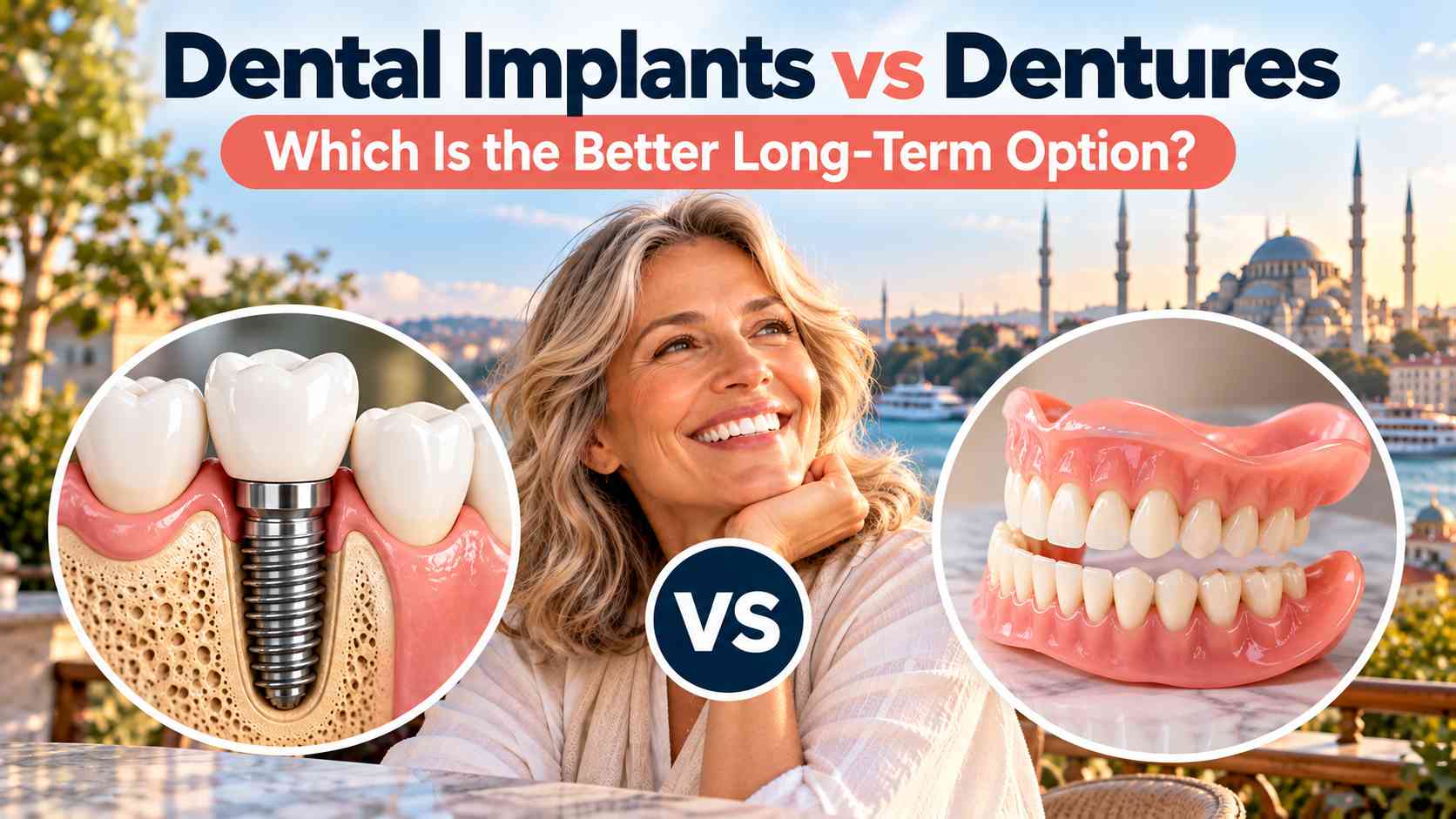
When replacing missing teeth, two of the most common options are dental implants and dentures. Both can restore your smile and improve everyday function, but they differ significantly in comfort, cost, durability, and long-term oral health.
Dental implants generally offer greater stability, better chewing function, and longer-lasting support, while dentures are typically more affordable upfront and don’t require surgery. However, the best choice depends on your oral health, budget, number of missing teeth, and personal preferences.
So, when comparing dental implants vs dentures, which option makes more sense in the long run? Let’s explore the differences, costs, and alternatives to help you make an informed decision.
Table of Contents
Dental Implants vs Dentures: Key Differences
Dental implants are artificial tooth roots, usually made of titanium, that are surgically placed into the jawbone. They support replacement teeth such as crowns, bridges, or full-arch restorations.
Dentures are removable appliances that replace missing teeth and surrounding gum tissue. They rest on the gums and, in the case of partial dentures, may also receive support from remaining natural teeth.
Both treatments can look natural, but their stability, maintenance requirements, and effects on jawbone health are different.
| Feature | Dental implants | Traditional dentures |
| Stability | Fixed or securely retained | May shift during use |
| Initial cost | Higher | Lower |
| Chewing ability | Generally better | May be limited |
| Comfort | Often feels more natural | May require adjustment |
| Jawbone health | Helps preserve surrounding bone | Does not prevent ongoing bone loss |
| Longevity | Implant fixtures may last decades | Often replaced every 5–10 years |
| Surgery | Required | Usually not required |
| Maintenance | Daily hygiene and dental checkups | Daily cleaning, adjustments and replacement |
| Treatment time | Often several months | Usually shorter |
For patients who want a fixed, long-term replacement, implants often provide important advantages. However, dentures remain a practical solution, particularly when surgery or higher upfront costs are concerns.
Pros and Cons of Dental Implants vs Traditional Dentures
Understanding the advantages and disadvantages of each treatment is essential before deciding.
Dental Implants: Pros and Cons
Advantages:
- Provide excellent stability when chewing and speaking.
- Can closely resemble natural teeth in appearance and function.
- Help preserve bone around the implant.
- Can last for decades with proper care.
- Fixed restorations don’t need to be removed daily.
- Can replace individual teeth, several teeth, or an entire arch.
Disadvantages:
- Higher initial cost.
- Require surgery and healing time.
- Some patients need bone grafting.
- Not suitable for every medical or dental condition.
- Implant complications and future prosthetic repairs are possible.
Dentures: Pros and Cons
Advantages:
- Usually more affordable initially.
- Generally don’t require surgery.
- Can replace multiple or all missing teeth.
- Often have a shorter initial treatment process.
- Can be adjusted or replaced as needed.
Disadvantages:
- May move during eating or speaking.
- Can cause irritation or sore spots.
- May reduce chewing efficiency.
- Don’t provide the same jawbone stimulation as implants.
- Often require relining or replacement as the mouth changes.
The bottom line: Implants generally offer better stability and long-term function, while dentures provide a less invasive and more affordable initial solution.
Which Is Better for Chewing, Comfort, and Jawbone Health?
Three of the biggest differences between implants and dentures become noticeable in everyday life: how comfortably you can eat, how natural your replacement teeth feel, and how the treatment affects your jawbone.
Are Dental Implants Better Than Dentures for Chewing?
Generally, yes.
Dental implants are anchored in the jawbone, providing a stable foundation for replacement teeth. This allows many patients to chew a wider range of foods more comfortably once healing is complete.
Traditional dentures rest on the gums and may shift under pressure, particularly lower complete dentures. Patients sometimes need to avoid hard or sticky foods or cut meals into smaller pieces.
Well-fitting dentures can still restore useful chewing function, but implants typically provide greater chewing stability and efficiency.
Do Dental Implants Feel More Natural Than Dentures?
Fixed implant restorations often feel closer to natural teeth because they remain stable during speaking and eating.
Dentures can feel bulky initially, and some patients experience movement, changes in speech, or irritation. Modern dentures can be comfortable and natural-looking, but they may require periodic adjustments.
Implants aren’t identical to natural teeth, as they lack the natural periodontal ligament. Nevertheless, many patients prefer the security of fixed implant-supported teeth.
Are Dental Implants or Dentures Better for Jawbone Health?
Dental implants generally have an advantage when it comes to preserving the surrounding jawbone.
After a tooth is lost, the jawbone in that area gradually changes because it no longer supports a natural tooth root.
Implants transfer functional forces into the bone, helping maintain bone around the implant. Traditional dentures don’t replace tooth roots and therefore cannot provide the same stimulation.
Over time, continued bone loss may affect denture fit and make future implant treatment more complicated.
However, implants don’t completely prevent bone loss, and maintaining healthy surrounding tissues remains essential.
Dental Implants vs Dentures: Cost and Long-Term Value
Cost is often the deciding factor when choosing between dental implants and dentures.
Traditional dentures usually cost less initially because they don’t require surgery. Implant treatment involves additional expenses for imaging, surgery, implant components, and prosthetic restorations.
However, comparing upfront prices alone doesn’t provide a complete picture.
What Affects the Cost?
Dental implant prices depend on the number of implants, bone condition, restoration type, and whether additional procedures are required.
Denture prices vary according to the type of appliance, materials, fabrication, and necessary adjustments.
| Cost factor | Dental implants | Traditional dentures |
| Initial treatment | Higher cost | Lower cost |
| Surgery | Required | Usually not required |
| Additional procedures | Bone grafting may be needed | Usually no implant-related procedures |
| Maintenance | Hygiene visits and possible prosthetic repairs | Cleaning, adjustments and relining |
| Replacement | Prosthetic components may need replacement | Entire dentures may need replacement |
| Long-term expenses | Depend on complications and maintenance | Depend on repairs and repeated replacement |
What Are the Total Lifetime Costs of Implants Versus Dentures?
Dental implants may have a higher upfront cost but can provide long-term service without requiring replacement of the implant fixtures.
Dentures generally cost less initially but often require adjustments, relining, and eventual replacement.
For example, someone wearing conventional dentures for 20 years may need several replacement appliances. An implant patient may retain the same implants throughout that period but still need prosthetic repairs or replacement.
This doesn’t mean implants are automatically cheaper over a lifetime. Their main value may come from improved comfort, chewing ability, stability, and quality of life.
When comparing costs, consider the total treatment price, expected maintenance, potential complications, and how long each restoration is likely to remain functional.
Are Payment Plans Available?
Some dental clinics offer installment payments, staged treatment plans, or financing options.
Availability varies by provider, and patients should confirm interest rates, deposits, repayment conditions, and what’s included in the quoted price.
For patients considering treatment abroad, exploring dental implants in Hungary or dental implants in Turkey can help identify treatment options and compare individualized quotations.
Which Lasts Longer: Dental Implants or Dentures?
Dental implants generally have greater long-term durability than traditional dentures, although neither option lasts forever without maintenance.
Dental implant fixtures can remain functional for decades when properly placed and maintained. However, the crowns, bridges, or full-arch prostheses attached to them may eventually need repair or replacement.
Implant longevity depends on factors including oral hygiene, smoking, medical conditions, bite forces, and regular dental monitoring.
Traditional dentures commonly need replacement approximately every five to ten years, although this varies between patients.
As the jawbone and gums change, dentures may become loose and require relining or adjustment.
Which Is Easier to Maintain?
Both options require regular care.
Implants need daily brushing, cleaning around the restoration, and professional checkups to monitor surrounding gum and bone health.
Removable dentures must be cleaned daily, and patients should regularly check their fit and condition.
A single implant crown may be relatively straightforward to maintain, while complex full-arch implant restorations may require specialized cleaning techniques.
Ultimately, implants may last longer, but neither treatment should be considered maintenance-free.
Full-Mouth Dental Implants vs Dentures: Which Is Better for You?
The best tooth replacement option depends on how many teeth are missing, the condition of your jawbone, and your overall health.
Full-Mouth Dental Implants vs Dentures for Seniors
Older adults frequently consider dentures because they are familiar, relatively affordable, and don’t usually require surgery.
However, age alone doesn’t prevent someone from receiving dental implants.
Many older patients can successfully undergo implant treatment, provided their medical condition, oral health, and bone anatomy are suitable.
For seniors struggling with loose dentures, implant-supported restorations may improve chewing, comfort, and confidence.
Dentures may remain preferable for patients who cannot undergo surgery, prefer removable appliances, or have financial limitations.
A dental professional should evaluate medical conditions, medications, bone availability, and maintenance needs before recommending treatment.
Dental Implants vs Dentures for Multiple Missing Back Teeth
Missing molars and premolars can significantly affect chewing because these teeth handle much of the force required to break down food.
Implant-supported crowns or bridges can provide fixed replacements for several missing back teeth.
Partial dentures are another option, particularly when several teeth are missing in different areas of the mouth.
Implants often provide greater stability, while partial dentures are generally more affordable and avoid surgery.
The best choice depends on the number and location of missing teeth, neighboring tooth health, available bone, and bite forces.
What If You Have Severe Jawbone Loss?
Significant jawbone loss can complicate conventional implant placement, but it doesn’t automatically rule out implant treatment.
Depending on the situation, a dentist may recommend bone grafting, alternative implant positioning, or a different type of restoration.
For patients who cannot receive conventional implants, removable dentures may still provide a functional solution.
A clinical examination and appropriate imaging are necessary to determine which approach is suitable.
What About Implant-Supported Dentures and All-on-4?
The choice isn’t limited to traditional dentures or individual dental implants.
Modern implant dentistry offers alternatives that combine improved stability with different levels of removability and treatment complexity.
Implant-Supported Dentures
Implant-supported overdentures attach to dental implants rather than relying entirely on the gums.
They typically provide better retention than conventional dentures and may improve chewing comfort.
Some designs are removable for cleaning, which can make maintenance easier for certain patients.
They still require implant surgery, and their attachments may need periodic maintenance.
All-on-4 Dental Implants
All-on-4 is a full-arch treatment approach that typically uses four strategically positioned implants to support a fixed set of replacement teeth.
Unlike conventional dentures, fixed All-on-4 restorations remain attached to the implants and don’t need to be removed daily.
They may be appropriate for patients missing most or all teeth in one jaw, provided the available bone and overall clinical circumstances support treatment.
For patients considering full-mouth rehabilitation, All-on-4 dental implants may offer an alternative worth discussing with a qualified implant specialist.
Dental Implants vs Dentures: Frequently Asked Questions
What Is the Best Tooth Replacement Option: Dental Implants or Dentures?
Dental implants are often preferable for patients seeking fixed, stable tooth replacement and long-term bone support. Dentures may be better for those who prefer a non-surgical or lower-cost option. The best choice depends on oral health, medical suitability, budget, and personal priorities.
Are Dental Implants Worth the Extra Money?
They can be, particularly for patients who value chewing stability, comfort, and fixed replacement teeth. However, implants aren’t automatically the most cost-effective option, and patients should consider maintenance and potential future expenses.
Can You Switch From Dentures to Dental Implants Later?
Yes. Many patients transition from dentures to implant-supported restorations. However, jawbone changes after tooth loss may affect implant eligibility or require additional procedures.
Do Dental Implants Look Better Than Dentures?
Both can look natural when properly designed. Dental implants may offer more stable support, while modern dentures can also produce excellent cosmetic results. Appearance depends on the prosthetic design, materials, and individual anatomy.
Are Implant-Supported Dentures Better Than Traditional Dentures?
For suitable patients, implant-supported dentures often provide better retention and chewing stability. However, they require surgery, cost more initially, and involve ongoing maintenance.
Can Dental Implants Replace All Your Teeth?
Yes. Full-arch implant-supported restorations can replace all teeth in the upper or lower jaw. Depending on the treatment plan, options may include fixed full-arch bridges or removable implant-supported overdentures.
Are Dentures Better for People Who Cannot Have Surgery?
Traditional dentures are often a practical option for patients who cannot undergo implant surgery. However, the final recommendation depends on the individual’s medical and dental circumstances.
Final Verdict: Dental Implants or Dentures?
For patients who are suitable candidates, dental implants generally offer better stability, chewing function, and long-term jawbone support than traditional dentures.
They may also provide greater comfort and potentially longer service life, although the initial investment is higher and ongoing maintenance remains necessary.
Dentures are still an effective solution for many patients, especially those who want to avoid surgery or need a more affordable way to replace missing teeth.
If you’re missing most or all your teeth, implant-supported dentures and All-on-4 restorations offer additional possibilities worth exploring.
Ultimately, the better long-term option is the one that balances oral health, comfort, functionality, cost, and personal preferences.
Explore Dental Implant Options With Booking Dentist
If you’re considering dental implants as an alternative to dentures, comparing treatment options can help you make an informed decision.
Booking Dentist allows you to explore dental implant treatments in destinations such as Hungary and Turkey, as well as All-on-4 full-mouth restoration options.
Compare available providers, request individualized treatment plans, and consult a qualified dental professional to determine which solution best suits your needs.