
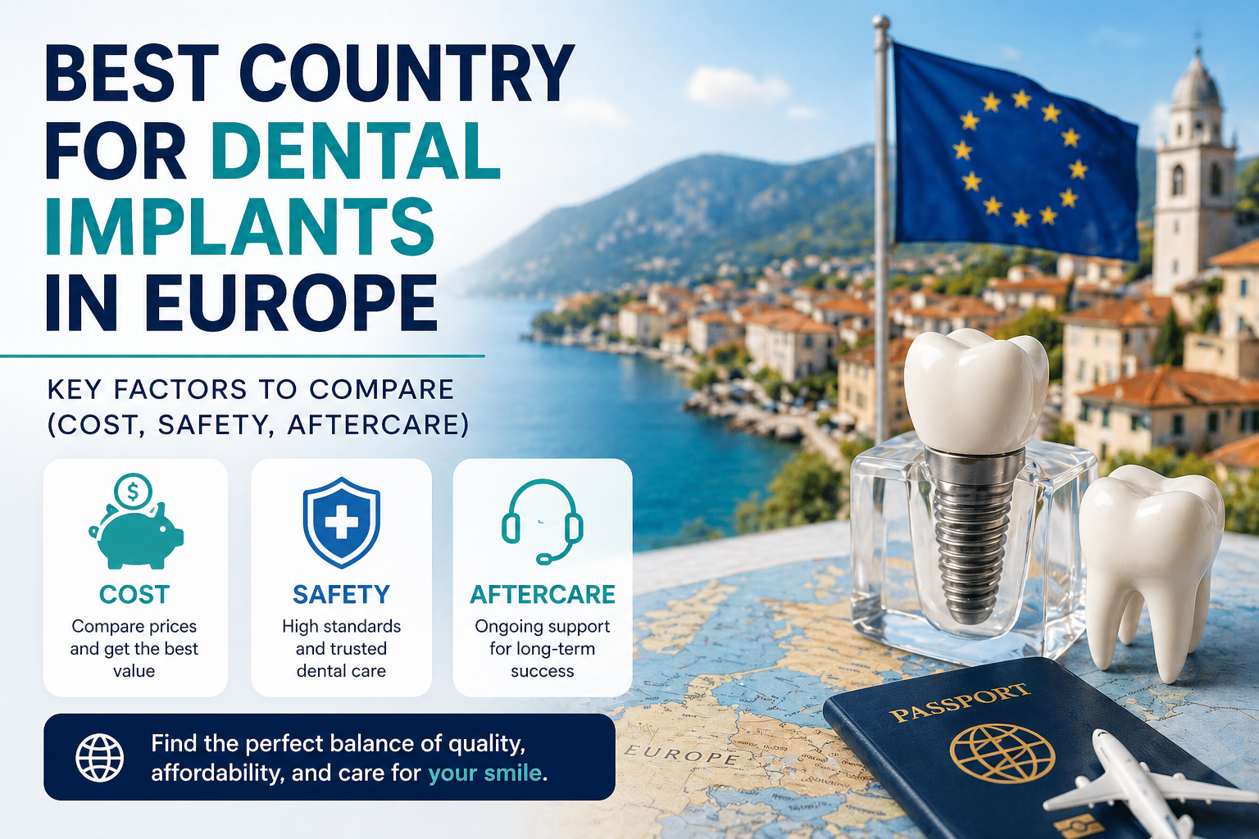
Best Country for Dental Implants in Europe: Key Factors to Compare (Cost, Safety, Aftercare)
When people search for the cheapest place for dental implants in Europe, they are usually not looking for the lowest number on a price list just for the sake of it. What they really want is a way to make implant treatment affordable without taking unnecessary risks. Dental implants are a major decision, both medically and financially, and most patients are trying to balance those two realities. They want treatment that fits their budget, but they also want it to be safe, durable, and worth the investment over time.
That is why the idea of “cheapest” is often too narrow to be useful on its own. In implant dentistry, the better question is usually about value. A lower upfront price can be attractive, but it does not automatically mean lower total cost in the long run. If treatment planning is incomplete, materials are unclear, or follow-up care is limited, the cheapest option can become more expensive later through complications, repairs, or retreatment. For patients comparing options across Europe, the goal should be to identify the clinic or destination that offers the strongest balance of cost, safety, transparency, and predictable outcomes.
- Best Country for Dental Implants in Europe: Key Factors to Compare (Cost, Safety, Aftercare)
- Why is this important?
- Why “Cheapest” Is Not Always the Best Question
- What Drives the Cost of Dental Implants in Europe
- Materials and Implant Systems
- Diagnostics and Treatment Planning
- Specialist Experience and Clinical Skill
- Aftercare and Long-Term Outcome
- Cheapest Dental Implants in Europe Without Insurance
- What Must Be Included in an Implant Quote
- Comparing Countries in Europe: What Matters Most
- Red Flags in Low-Cost Implant Offers
- Reframing “Cheapest Place for Dental Implants in Europe” as “Best Value”
- Find and Compare Trusted Implant Clinics Across Europe With Booking.Dentist!
Why is this important?
This is especially important for people researching the cheapest dental implants in Europe without insurance. When there is no insurance coverage to offset expenses, every part of the quote matters. But even in that situation, it is important to compare more than the advertised price of the implant itself. The quality of diagnostics, the experience of the clinician, the implant system being used, and the aftercare arrangements all influence whether treatment represents real savings or just a lower entry price with hidden trade-offs.
This guide reframes the “cheapest place” question in a more practical way. Instead of treating dental implants like a simple commodity, it explains what actually drives costs, what affects implant success, what patients should expect in a quote, and how to compare countries and clinics across Europe with a clearer understanding of risk and value.
Why “Cheapest” Is Not Always the Best Question
Dental implants are not comparable to booking the lowest airfare or finding the least expensive hotel. They are a form of clinical treatment that involves surgery, healing, prosthetic work, and long-term maintenance. That means the true cost of implant treatment cannot be understood by looking at one number in isolation. A quote may appear low at first glance, but if essential parts of the process are excluded or minimized, the lower price may not reflect better value.
One of the main problems with the search for the cheapest place for dental implants in Europe is that it often encourages patients to compare headline prices rather than complete treatment plans. Clinics may advertise the price of a single implant fixture, but that does not necessarily include diagnostics, the abutment, the final crown, follow-up visits, or any preparatory procedures such as bone grafting. The result is that two offers can look similar in a search result while representing very different standards of care and very different final costs.
Focusing on value is often the smarter choice
There is also the issue of outcomes. Dental implants are designed to function over the long term. Their success depends not only on correct placement, but also on planning, bone quality, bite alignment, prosthetic design, hygiene support, and aftercare. If any of these elements are weak, a lower price at the start may lead to greater expense later. In that sense, “cheapest” can be misleading because it ignores the cost of future corrections, discomfort, or replacement.
Want to learn more? Read our full blog about Cheap, High Quality Dental Implants for a deeper breakdown.
A more useful framework is best value. Best value does not mean choosing the most expensive clinic, and it does not mean ignoring affordability. It means asking whether the treatment price is justified by what is included, by the quality of care, and by the likelihood of a stable result. For most patients, that is a much more practical way to compare implant options across Europe.
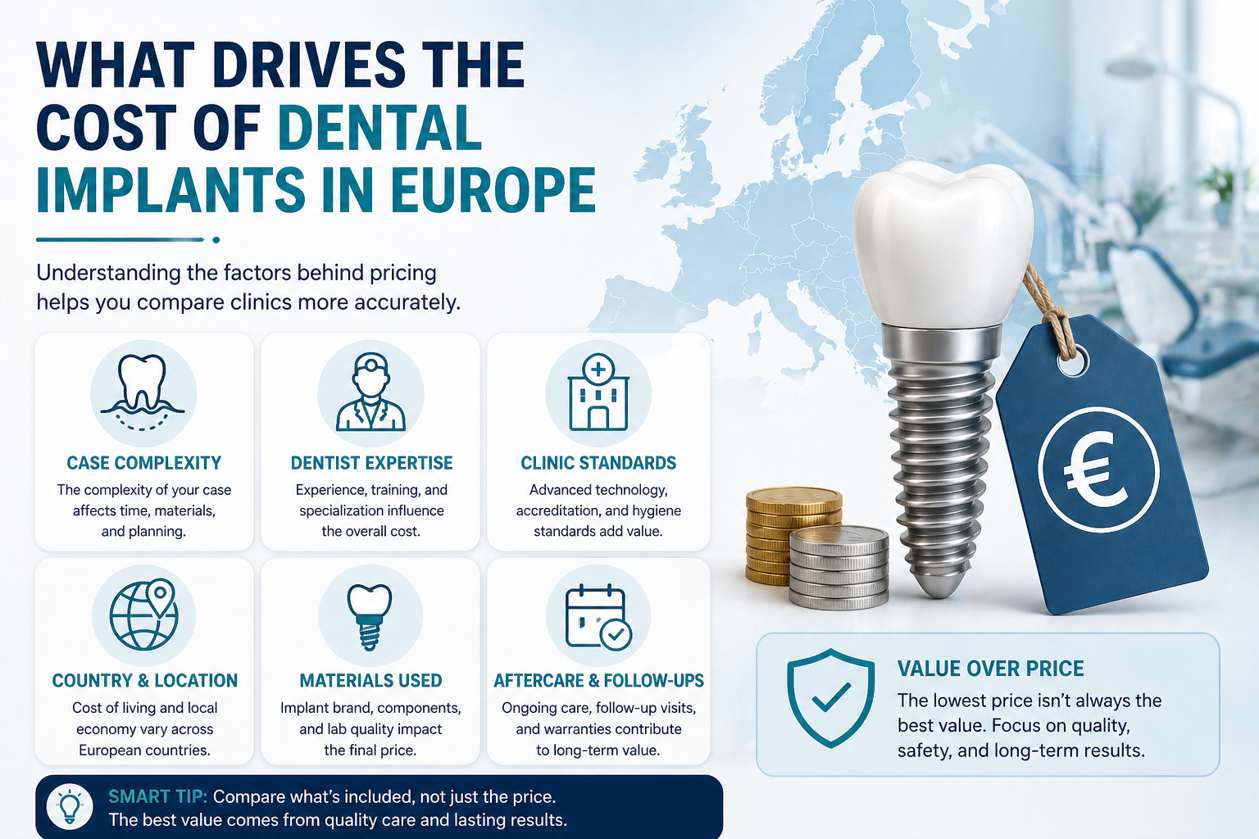
What Drives the Cost of Dental Implants in Europe
Implant prices vary across Europe for many reasons, and not all of them are signs of better or worse quality. Some differences are driven by broader economic factors such as wages, rental costs, operating expenses, and taxation. A clinic in one country may genuinely be able to offer lower prices because its cost base is lower, not because it is cutting corners. This is one reason why some European destinations are consistently viewed as more affordable for implant treatment.
At the same time, part of the cost difference comes from clinical and technical choices. Implant systems differ in price, and so do the materials used for abutments and crowns. Some clinics invest more heavily in diagnostics, digital planning, in-house technology, or laboratory partnerships. Others may operate on higher volumes and use more standardized workflows, which can reduce cost without necessarily reducing quality. The challenge for patients is that these differences are not always visible in a basic quote.
How Case Complexity Affects Cost and Treatment?
Another major factor is case complexity. A straightforward single implant in a patient with good bone volume is very different from a case involving bone grafting, sinus augmentation, multiple missing teeth, or a full-arch restoration. When patients compare prices online, they are often comparing incomplete or oversimplified examples. In reality, the complexity of the individual case can change the final cost significantly, even within the same clinic or country.
This is why patients looking for the cheapest dental implants in Europe without insurance should be cautious about broad price comparisons. A low advertised price may be accurate for a very simple case but not relevant to their actual needs. The most reliable approach is to understand the components of treatment and compare like with like.
Materials and Implant Systems
One of the most important cost drivers in implant dentistry is the implant system itself. Dental implants are not generic in the way many patients assume. Different manufacturers produce systems with different levels of research support, availability, design features, and long-term clinical data. A clinic using a widely recognized implant brand may charge more than one using a lesser-known system, but that difference can be meaningful.
Established implant systems are often supported by years of published research, consistent manufacturing standards, and broader international availability. This matters not only at the time of treatment, but later as well. If a component needs adjustment or replacement, it is generally easier to manage when the system is widely recognized and supported. By contrast, a lower-cost or less familiar implant brand may save money upfront but create complications if future servicing is needed.
The materials used above the implant also affect price
The implant fixture is only one part of the treatment. The abutment and final restoration, whether that is a crown, bridge, or prosthetic arch, contribute heavily to both cost and outcome. Materials such as zirconia often cost more than metal-based alternatives, but they may offer advantages in durability, esthetics, or patient preference depending on the clinical context.
When evaluating the cheapest place for dental implants in Europe, patients should ask not just what the implant costs, but which implant system is being used and what type of restoration is included. This does not require expert technical knowledge. It simply means requesting clarity rather than accepting a low price without context.
Diagnostics and Treatment Planning
Another major driver of both cost and outcome is diagnostics. Proper implant treatment begins long before surgery. It requires assessment of bone structure, spacing, neighboring teeth, gum condition, bite relationship, and the overall health of the mouth. In many cases, that also means digital X-rays and three-dimensional imaging such as CBCT scans. These steps add cost, but they are central to safe and predictable planning.
When clinics compete aggressively on price, diagnostics are sometimes one of the first areas patients overlook. A low-cost offer may sound attractive if it seems to include everything, but if treatment planning is rushed or based on limited imaging, that lower price may reflect reduced preparation rather than greater efficiency. Since implant placement depends on precision, weak planning can increase the risk of poor positioning, esthetic compromise, nerve proximity issues, or long-term instability.
Good treatment planning also includes discussion of alternatives
In some cases, an implant may be appropriate. In others, there may be reasons to consider a bridge, removable solution, or staged treatment approach. A clinic focused only on selling the implant itself may not present these options clearly. That is another reason why value matters more than price alone. A well-planned case may cost more upfront, but it is more likely to deliver a functional and durable result.
For patients comparing options across Europe, the quality of planning should be seen as part of the treatment itself, not an optional extra. If diagnostics are excluded from the headline price, that does not automatically make a clinic poor value, but it does mean the comparison is incomplete unless those costs are added back in.
Specialist Experience and Clinical Skill
Implant dentistry involves both surgical placement and prosthetic restoration. Even when a clinic advertises a competitive price, the expertise of the clinician remains one of the strongest predictors of outcome. Experience matters not only in placing implants, but in choosing the right cases, planning the correct angulation and position, managing complications, and ensuring the final restoration functions properly.
This is where the search for the cheapest dental implants in Europe without insurance can sometimes become too narrow. A lower price may appear to save money, but if the clinician has less specific implant experience, the actual risk profile of the treatment may be different. By contrast, a clinic with a strong implant focus may charge more because of the training, systems, and expertise required to deliver consistent results.
Patients do not necessarily need the most famous or most expensive specialist. But they should look for relevant experience, clear communication, and a willingness to explain the case in realistic terms. A clinician who discusses limitations, possible complications, healing timelines, and maintenance usually inspires more confidence than one who presents implants as a quick, simple, one-price solution for everyone.
In practical terms, experience is part of value. It may not always show up neatly in a price comparison, but it strongly affects the reliability of the result.
Aftercare and Long-Term Outcome
One of the most overlooked parts of implant comparison is aftercare. Yet this is exactly where many low-price offers become less attractive under closer review. Implant treatment does not end when the implant is placed or even when the crown is attached. There is a healing process, a functional adaptation period, and ongoing maintenance over time. Clinics that build aftercare into the process may charge more, but they are often offering something much closer to complete treatment.
Aftercare can include post-surgical review, healing assessments, bite adjustments, hygiene instructions, and follow-up checks once the final restoration is in place. It may also involve warranty terms or guidance on what to do if problems arise after returning home. For patients traveling across borders, this is especially important. If a complication occurs, the distance between patient and provider can turn a manageable issue into a stressful and expensive one.
This is why patients searching for the cheapest place for dental implants in Europe should ask how follow-up is handled. Is it included? Is there a clear timeline? What happens if the final crown needs adjustment? What support is available once the patient has left the country? A clinic may appear affordable at the treatment stage but offer limited support afterward, which changes the real value of the offer.
Long-term implant success depends not just on placement, but on maintenance and monitoring. A quote that includes structured aftercare can represent better value than a lower quote that stops at the moment the procedure is completed.
Cheapest Dental Implants in Europe Without Insurance
For patients without insurance, the pressure to control costs is completely understandable. Implant treatment can represent a significant personal expense, and it is natural to compare countries and clinics in search of affordability. But the lack of insurance makes careful comparison even more important, not less. When the patient is responsible for the entire bill, hidden costs and incomplete quotes become much more consequential.
One of the most common issues is the difference between a base price and a full treatment price. A clinic may advertise a low implant cost, but that figure may exclude diagnostics, extractions, bone grafting, temporary restorations, the final crown, or review appointments. For a patient paying entirely out of pocket, these missing items can change the budget substantially. That is why the question is not only where the cheapest dental implants in Europe without insurance can be found, but what exactly is being compared.
Travel-related costs should also be part of the equation. Flights, accommodation, local transport, time away from work, and the possibility of more than one visit all contribute to the total cost. In some cases, a clinic with a slightly higher treatment fee but fewer logistical complications may offer better overall value than a lower-priced clinic that requires more travel or more fragmented scheduling.
Patients without insurance should therefore think in terms of total private-pay cost, not just implant price. That broader calculation is more realistic and usually more helpful.
What Must Be Included in an Implant Quote
A meaningful comparison between clinics is only possible when the quote is complete enough to show what is actually being offered. Many misunderstandings in implant pricing come from partial quotes, vague package descriptions, or marketing language that emphasizes the implant while omitting essential parts of treatment.
A reliable quote should clearly state whether diagnostics are included, including any X-rays or CBCT imaging required for planning. It should specify the surgical placement of the implant itself, the components that connect the implant to the restoration, and the type of final prosthetic solution being provided. If a temporary tooth or temporary prosthesis is needed, that should also be addressed. Follow-up appointments, post-operative reviews, and any adjustment period should be explained rather than implied.
The quote should also make clear what is not included. If bone grafting, sinus lifts, sedation, extractions, or additional appointments may add to the cost, that should be outlined in advance as far as possible. The more transparent the quote, the easier it is to evaluate value and compare providers across countries.
For patients researching the cheapest place for dental implants in Europe, this point is critical. A low number without detailed inclusions is not a strong basis for comparison. A slightly higher number with transparent inclusions often gives a much better picture of the real cost.
Comparing Countries in Europe: What Matters Most
There is no single best country for every implant patient, because the right choice depends on budget, travel needs, treatment complexity, and personal priorities. However, some general comparison factors are more useful than others. Regulation matters because it provides a baseline framework for licensing, materials, and clinical oversight. Accessibility matters because implant treatment often involves staged care and possible follow-up. Communication matters because informed consent and realistic planning depend on clarity.
Clinical infrastructure also plays a role. Some destinations have long-established reputations for treating international patients and may have systems in place to support consultation, scheduling, and coordination. That does not automatically make them the best option for everyone, but it can make the process smoother.
The key is to compare countries in terms of overall suitability rather than relying only on broad price averages. A destination may be affordable, but if travel is difficult and aftercare is impractical, the lower cost may not translate into better value. On the other hand, a country that is slightly more expensive may offer better continuity, shorter travel times, and more predictable logistics.
Patients comparing European options should therefore think in layers: treatment price, travel practicality, regulatory confidence, communication quality, and aftercare feasibility. That broader perspective is much more useful than a narrow search for the lowest number.
Red Flags in Low-Cost Implant Offers
Affordability itself is not a red flag. Many clinics in Europe can genuinely offer lower prices because of lower operating costs or more efficient systems. But some signs should prompt caution when comparing low-cost implant offers.
One warning sign is a quote that seems unusually low without a clear explanation of what is included. Another is a clinic that avoids discussing implant brands, materials, diagnostics, or aftercare in specific terms. Pressure to commit quickly can also be a concern, especially if it appears before a full case assessment has taken place. Similarly, a clinic that offers certainty without discussing limitations or healing timelines may be oversimplifying treatment.
Red flags do not automatically mean a clinic should be ruled out, but they do indicate the need for more questions. In implant dentistry, transparency is one of the most useful indicators of seriousness and professionalism. Clinics that explain the process clearly, outline what is included, and discuss possible additional needs are usually easier to evaluate than those that rely heavily on headline pricing alone.
Reframing “Cheapest Place for Dental Implants in Europe” as “Best Value”
In practice, the best answer to the search for the cheapest place for dental implants in Europe is not a single country name. It is a better method of comparison. Patients are usually trying to solve a real problem: how to access implant treatment at a manageable cost. But the safest and most useful response is to shift the question from “Where is it cheapest?” to “Where will I get the best value for my money?”
Best value means the treatment is affordable in relation to what is included. It means diagnostics are adequate, materials are clear, the clinician is experienced, the quote is transparent, and aftercare is considered from the start. For patients paying privately and comparing the cheapest dental implants in Europe without insurance, this approach is even more important because the margin for financial surprises is smaller.
Price matters, and it should matter. But implants are a long-term solution, and their true value lies in whether they function well, heal properly, and remain stable over time. The cheapest option is not always the least expensive in the long run. The best-value option is the one that balances cost with safety, planning, and predictable outcome.
Find and Compare Trusted Implant Clinics Across Europe With Booking.Dentist!
If you’re exploring dental implant options abroad, the best next step is to compare clinics based on your actual treatment needs—not just a headline price. Reviewing detailed treatment information and requesting a personalized plan can help you understand what is included, how the case will be planned, what materials may be used, and what the expected total cost is likely to be.
Use Booking.Dentist to compare clinics, review treatment information, and request a plan tailored to your case. A more structured comparison makes it easier to weigh cost, safety, experience, and aftercare before making a decision.
Get implant information or request a treatment plan!
Taking this approach gives you a better chance of finding the right balance between affordability, transparency, and long-term success.